How to Verify a Chinese Company
The five-layer checklist for verifying a Chinese company or supplier, in order — what to do at each step, what the result actually proves, and when to escalate.
15 min read
Most articles on how to verify a Chinese company hand the buyer a flat list of tips: check the license, ask for photos, look at certifications, watch out for red flags. The list is not wrong — every item on it belongs somewhere — but the format leaves the buyer to do the hardest part of the work themselves, which is figuring out the order. Which check do you run first? Which check, if it comes back clean, lets you stop worrying? Which check is doing real work versus which one is just procedure theatre?
This guide is sequenced. Five layers, ordered from cheapest to costliest, with one rule that runs through all of them: at the end of each layer, you should know two things — what the layer ruled out, and what it did not. The layers compound. The point at which the cost of doing one more layer yourself exceeds the cost of commissioning an independent verification report is the escalation moment. We name it at the end.
Throughout this guide, the term "supplier" refers to the Chinese company you are evaluating for an order. The procedure works the same whether that company is a factory, a trading firm, or a hybrid — though identifying which it is is itself one of the checks.
A reality check before we start
The procedure below is the procedure. It is also the procedure most foreign buyers cannot fully execute on their own, and any guide that pretends otherwise is misleading. Four structural barriers sit between a Western buyer and the registry data that would answer their questions.
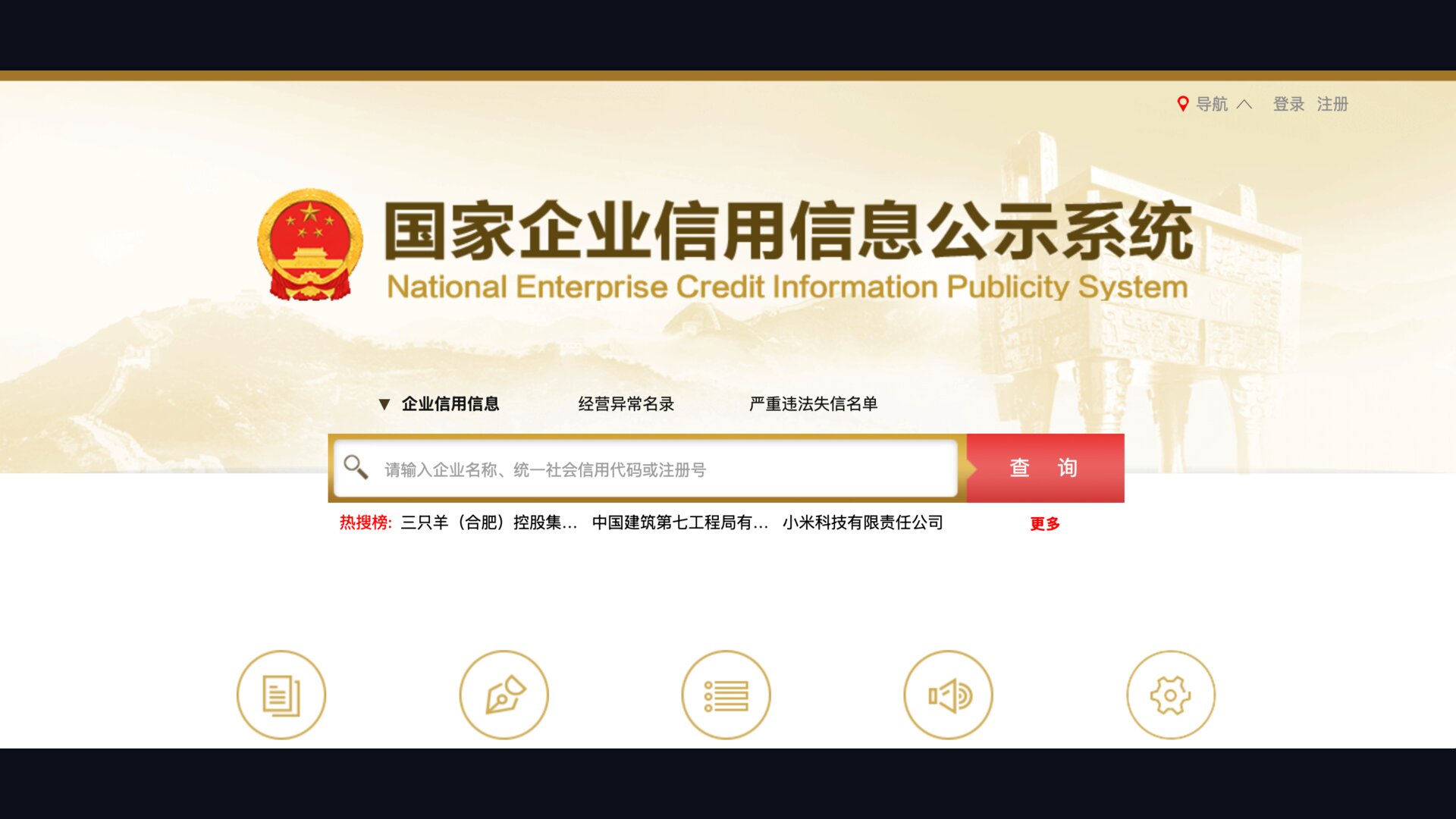
Chinese-character captchas, on every search, and inconsistent foreign-IP behaviour. The SAMR registry at gsxt.gov.cn is reachable from anywhere on paper. In practice the behaviour is uneven: in our own testing from Madrid the site loaded fine in Safari with no account, while Chrome on the same machine on the same network was IP-blocked entirely. Across foreign IP ranges this kind of inconsistency is the norm — what worked yesterday will not necessarily work today, and what loads in one browser will not necessarily load in the next. When the site does load, every lookup is gated by a Chinese-character captcha that asks the user to identify or arrange Chinese characters. For a buyer who does not read Chinese, even the basic public lookup becomes a hunt-and-peck exercise of refreshing the captcha until one happens to be visually solvable. The State Taxation Administration's national fapiao verification portal — inv-veri.chinatax.gov.cn — adds two more layers on top: it asks first-time users to install a Chinese government root certificate, captcha-gates every verification, and caps each fapiao at five verification attempts per day. These sources are publicly accessible. Running them productively from a foreign device, in a foreign-language browser, against unfamiliar UI conventions, is not the ten-minute exercise it appears to be on paper.
Account-gated features require a Chinese national ID. The basic read-only search on gsxt.gov.cn is genuinely public — the captcha gauntlet aside, no login is required to see the registered name, status, registration date, registered capital, business scope, and address. But every deeper feature on the SAMR system — viewing the full annual report filings, accessing the full administrative-penalty case file, filing a complaint, submitting corporate filings — requires creating an account, and that account requires a Chinese national ID number (身份证) at registration. A foreign passport will not register. So even a buyer with a sourcing agent on the ground in Shenzhen has a limit on what that agent can pull from the system unless the agent is a Chinese national operating in their own name.
The Chinese-language interface, end to end. Every primary source named in this guide — gsxt.gov.cn, the State Taxation fapiao portal, local-tax-bureau fapiao lookups, the SAMR administrative penalty database, Baidu Maps for satellite imagery of industrial parks — is published in simplified Chinese. There is no official English mirror. Machine translation handles the navigation chrome but breaks down on the substantive content: business-scope strings packed with regulatory terms of art, the legal phrasing of an Abnormal Operation entry, the precise language of an administrative penalty record. The fields that matter most for verification are the ones machine translation handles worst.
Interpretation, not just translation. Even with a clean translation, the meaning is not self-evident to a buyer outside the system. Is a registered capital of 5 million RMB high or low for this product category and region? Is this particular business-scope wording unusually narrow, or standard for the industry? Does this kind of Abnormal Operation entry typically clear in two weeks, or does it indicate something the supplier will not be able to resolve? Is the legal representative on this license also the legal representative on three other related entities, and what does that pattern of cross-directorship mean? None of those are translation questions; they are interpretation questions that require operating context in the Chinese commercial environment.
We name these barriers up front because the rest of this guide describes what would happen if the barriers were not there. For self-doer buyers with on-the-ground partners in China — a sourcing agent, a friend, a relocated colleague who reads regulatory Chinese fluently and who has the patience to run captcha gauntlets — the procedure works directly. For everyone else, the value of the guide is to know what is being checked and why, so that when the verification work has to be commissioned, the buyer knows what they are buying and can read the resulting report critically. That is also a verification skill.
Layer 1 — Confirm the legal entity exists
The first question is not "is this supplier good," it is "does this supplier exist as a legal entity at all." The public read-only search is free; the anti-bot and captcha gating turn what should be a ten-minute lookup into a slow exercise for anyone not used to the interface (see the reality check above).
The State Administration for Market Regulation (SAMR) operates the National Enterprise Credit Information Publicity System — gsxt.gov.cn — which is the public registry for all corporate entities in mainland China. The interface is Chinese-language only. Search by the company's legal Chinese name or by its 18-digit unified social credit code. The free public view returns the entity's date of establishment, registered capital, legal representative, registered address, and business scope, plus any operating-status indicators.
Before you search, get the unified social credit code from the supplier in writing — Email, contract draft, or pro forma invoice. Two reasons. First, transliteration of Chinese company names is ambiguous; "Beijing Xinhua Trading" can match a dozen registered entities. The 18-digit code is unique. Second, a supplier who hesitates to give you their unified social credit code in writing is telling you something before you have even searched.
For Hong Kong-incorporated entities, the equivalent lookup is the Hong Kong Companies Registry at cr.gov.hk. Many Chinese exporters use a two-body structure — an HK parent that handles invoicing and a mainland subsidiary that handles operations — so verify both registries if the supplier presents an HK entity for contracting.
What this layer rules out: that the entity does not legally exist, that the legal name on your contract draft is misspelled, that the registered capital is wildly out of line with the order size (a registered capital of 100,000 RMB on a 500,000 USD order is a structural question).
What this layer does not rule out: anything about how the company actually operates, whether it is solvent, whether it is the real producer of the product you are sourcing, whether it has been involved in public-record matters, or whether the storefront you are talking to and the legal entity on the registry are doing the same thing.
Layer 2 — Read the business license
The business license (营业执照) is the supplier's primary identity document. Every legitimate Chinese company has one. Ask for a colour scan or photograph of theirs, then read it line by line.
Six fields matter:
Unified social credit code (统一社会信用代码). Eighteen alphanumeric characters. Cross-check this against what you found on gsxt.gov.cn in Layer 1 — it must match exactly.
Company name (名称). The Chinese legal name. The English name on the storefront or in the contract is a translation — it has no legal standing on its own. The name on the license is the name your contract and your bank wire must use.
Registered capital (注册资本). Denominated in RMB (occasionally USD or HKD). Two patterns are worth questioning: registered capital of 50,000–100,000 RMB on a company representing manufacturing capability for large orders (Chinese law allows minimal registered capital, but a serious factory typically files higher); or "paid-in capital" much lower than "subscribed capital" — in China since 2014 capital can be subscribed without being paid in, so the relevant figure is what has actually been paid.
Legal representative (法定代表人). A single Chinese citizen named as the legally responsible officer. Confirm in your communications that this person exists, is reachable, and is the same person signing contracts. Frequent change of legal representative across short windows is worth a question.
Registered address (住所). This is the address where the company is legally domiciled — it is sometimes the same as the factory, often not. A mismatch between registered address and factory address is not automatically a problem; many Chinese companies use a separate registered office and a separate manufacturing facility. The check is whether both addresses, when independently verified, resolve to real locations consistent with the company's claimed activity.
Business scope (经营范围). A list of activities the company is licensed to conduct. This is where you discover whether you are talking to a factory or a trading company. Scope containing manufacturing language (生产, 制造, 加工) for your product category indicates a factory. Scope reading wholesale, retail, import-export, or commercial trade (批发, 零售, 进出口, 商品贸易) without manufacturing language indicates a trading company. Hybrid scopes are common — a company can have both manufacturing and trading rights — and that hybrid pattern is worth a direct question about which side of the business is delivering your specific order.
We cover the business license document in deeper detail in a forthcoming guide; for now, the Trade Signal issue from 8 May 2026 walks through a sample license line by line.
What this layer rules out: identity confusion between the storefront and the legal entity, gross mismatches between claimed capability and registered scope, capital structures too thin to support the order size.
What this layer does not rule out: that the license was authentic when issued but the entity has since gone dormant, that the legal representative has changed, that the company is on the Abnormal Operation List, or that the operating address has shifted.
Layer 3 — Check operating status and abnormal-operation flags
The same SAMR registry that confirmed the entity in Layer 1 also publishes its current operating status. This is where the registry stops being a static identity document and starts behaving like a live signal.
Three things to read.
The annual report filing record (企业年报). Chinese companies are required to file an annual report with SAMR each year. The filing window closes on 30 June. The public registry shows whether the company has filed for the current year and for prior years. A clean multi-year filing history indicates an operator that is actively maintaining its corporate compliance. A missed filing — particularly if 30 June has passed and the current year shows nothing — is worth asking about directly.
The Abnormal Operation List (经营异常名录). SAMR flags companies into this status for one of several specific reasons: failure to file the annual report on time, failure to disclose required information, an address verified as unreachable on inspection, or other defined compliance gaps. An active Abnormal Operation List entry is a real signal. It does not automatically mean the supplier is dishonest; small Chinese companies sometimes miss filings, and the status can be cleared by rectifying the gap. What it does mean is that you should ask for documentation that the matter has been resolved — or is being resolved — before you commit a meaningful order.
Administrative penalty records (行政处罚信息). SAMR and other regulators publish administrative penalties imposed on registered companies — for example, advertising compliance violations or product quality findings. Public-record matters of this kind are searchable on the registry and are different in kind from the speculative "red flags" some incumbents reference. Real penalty records are documented; absence of records does not prove absence of problems, but the presence of recent significant penalties is a concrete signal.
What this layer rules out: dormant entities, multi-year filing gaps, recent regulatory findings on the public record.
What this layer does not rule out: anything about manufacturing capability, beneficial-owner changes, undisclosed upstream partners fulfilling the order, or post-audit drift in operations.
Layer 4 — Verify capability signals (the bench tests)
Layers 1–3 establish that you are dealing with a real, compliant, operating company. Layer 4 establishes that the company actually does what it says it does. Four bench tests, in declining order of how cheaply you can run them.
The VAT invoice (fapiao) authenticity check. Ask the supplier for a real fapiao they have issued — either for the sample order to you, or for a previous buyer with names redacted. A fapiao carries a unique fapiao code and number, which is verifiable in the State Taxation Administration's national fapiao verification portal at inv-veri.chinatax.gov.cn. The portal is publicly accessible from anywhere — no IP block — but it asks first-time users to install a Chinese government root certificate, captcha-gates every check, and caps each fapiao at five verification attempts per day. The interface is Chinese-language only. What the fapiao document itself tells you, even before the portal lookup, is informative: the structure of the document, the issuing tax bureau code, the invoicing rate, and whether the issuing-entity name matches the business license name. A valid fapiao confirms three things at once: the company has a real tax registration, it is currently invoicing (so it is operating), and the invoicing rate is consistent with its declared business type. A factory issuing trading-rate fapiao for a manufacturing-scope order is a mismatch worth understanding.
The factory-address bench test. Resolve the factory address on a satellite mapping service — Baidu Maps offers the most accurate Chinese-territory coverage and is reachable from anywhere, though its interface is Chinese-language only. Western mapping tools (Google, Apple, OpenStreetMap-based services) are a fallback with lower resolution on Chinese industrial zones but a familiar interface. The address should resolve to an industrial-zone parcel that physically could contain the kind of operation the supplier claims. A factory of one thousand workers does not fit in a thirty-square-metre serviced office. A precision-electronics line does not run out of a converted residential building. These are coarse signals, but coarse signals at zero cost are worth catching.
Photo and video evidence with timestamps. Ask the supplier for three or four photographs of the production line, taken today, with the date and a small landmark visible. The photographs should arrive with EXIF metadata intact — you can read EXIF in any image viewer. The EXIF timestamp, GPS coordinates (when present), and camera model are useful cross-checks against the claim. A video walkthrough is even better; a real factory operator running a real line can produce a five-minute uncut video tour on a working day. A supplier who cannot produce one, or who produces stock footage when asked, is telling you something.
Trading-company-vs-factory disclosure. This is the question incumbents focus on, and it deserves its own treatment because the mis-disclosure pattern recurs in B2B-sourcing accounts. A Chinese trading company representing itself as a factory is not always a problem — trading companies aggregate factories, manage quality, and can deliver a coherent service. The problem arises when the buyer believes they are contracting with the factory of record, when in fact the order will be fulfilled by an upstream factory the trading company has not disclosed and whose own compliance the buyer has not verified. The check is to ask, in writing, "Is the company we are contracting with the entity that will manufacture this order, or will it be fulfilled by an upstream partner? If by a partner, who?" The answer, in writing, sets the next layer's scope.
What this layer rules out: a paper-only company with no real operating signals, gross capability mismatches between stated and observable activity, undisclosed upstream fulfilment.
What this layer does not rule out: product quality drift between sample and bulk, beneficial-owner rotation across multiple legal entities, financial fragility of the entity, or anything about the upstream factory if one is disclosed at this stage.
Layer 5 — When to escalate to an independent report
Three layers of registry work, one layer of bench tests, ten or twelve hours of careful desk research. At some orders, at some structural complexity, the next useful step is no longer something the buyer can run themselves.
The escalation moment has three triggers.
Transaction size. When the deposit or first order is large enough that a 199 USD independent verification report is a rounding error on the loss the buyer would absorb if the supplier turns out to be something other than what they represent. The maths is not subtle: a 50,000 USD order with a 30% deposit puts 15,000 USD at risk; spending 199 USD to harden the underlying entity check is a fraction of one per cent of that exposure.
Structural complexity. When there is an HK entity in front of a mainland entity, when the storefront is a trading company sourcing from an undisclosed upstream factory, when the buyer has been redirected from initial outreach to a different invoicing entity, or when the supplier has multiple legally distinct entities under the same brand. Each of these is a structural pattern that registry checks alone do not resolve.
An open question that desk research surfaced and cannot resolve. An Abnormal Operation entry whose status the supplier explains but cannot document. A registered address that does not resolve to the factory address and where the supplier's explanation is plausible but unconfirmed. A fapiao the supplier cannot produce within a working day. Any of these is the kind of open question that an independent report — built on registry data, third-party records, and where appropriate on-the-ground verification — can close.
What an independent verification report adds that desk research from outside China typically cannot: efficient operation of the Chinese-language primary sources without losing afternoons to captcha gates, root-certificate prompts, and Chinese-only UX; native-language and native-context interpretation of business-scope strings, Abnormal Operation entries, and administrative-penalty records, where machine translation falls short and where the meaning of a record depends on operating knowledge of the Chinese commercial environment; access to account-gated SAMR features that require a Chinese national ID to register; cross-registry consolidation (mainland SAMR + Hong Kong Companies Registry + relevant industry licences); trade history validation; beneficial-owner trace through corporate layers; and a written record in English the buyer can file and refer back to if anything later turns out to be different from what was represented. The Sinolinks verification report is built on this discipline.
What an independent report looks like, page by page, is shown on our report sample — the same layout and field-by-field depth we deliver on every commissioned verification, whether the underlying company is a Tier-1 manufacturer or the small and mid-sized supplier most foreign buyers actually contract with.
The platform-badge question
A buyer who has worked through Layers 1–4 will have noticed that the suppliers they are evaluating often display platform-issued badges — Alibaba Verified Supplier, Gold Supplier, Trade Assurance, Made-in-China Audited Supplier, Global Sources Verified. The question of what those badges actually mean is worth its own short section, because it is where the procedure intersects with the question buyers most often ask first.
Platform badges are audits a platform operator commissions against its own published programme. The audits are real — third-party inspection firms conduct them under defined protocols — and for what they are designed to do, they work. They confirm that the entity exists, that the storefront represents an operator with some level of manufacturing or trading capability, and that the company has met the platform's published criteria on the day of the audit. Per the platforms' own published programme descriptions, that is what the badge attests.
What platform badges are not designed to attest, by design: ongoing quality control between sample and bulk; the identity of the upstream factory if the storefront is operated by a trading entity; beneficial-owner changes after the audit; the supplier's regulatory standing on the public registry between audit cycles; or anything about the relationship between the storefront brand and the underlying legal entity the buyer is actually contracting with.
The US Trade Representative's Notorious Markets reviews have named Alibaba Group's consumer-facing AliExpress in 2021 and 2022 over seller-vetting concerns — a public-record matter, distinct from the B2B Alibaba.com platform but illustrative of the gap between platform attestation and independent verification. We treat this distinction at length in our Alibaba supplier verification guide.
Both can be true at once: a Verified Supplier can be a credible producer, and the programme can leave specific questions outside its scope. The buyer's job is to know which side of that gap their order sits in.
Hong Kong entities and the two-body structure
Many Chinese suppliers contract through a Hong Kong entity while operating through a mainland subsidiary. This is a legitimate, common structure — HK provides simpler invoicing for international trade, cleaner banking for inward USD wires, and a contract law regime more familiar to foreign buyers — but it does add one layer to the verification work.
The check is to confirm three things. The HK entity exists on cr.gov.hk and is Live, not Dissolved. The mainland operating entity exists on gsxt.gov.cn and has the manufacturing or trading scope the contract assumes. And the contractual relationship — who you are contracting with, who is invoicing you, who is producing the goods — is documented across both entities consistently. A two-body structure where the contract names the HK entity, the invoice comes from the mainland entity, and neither entity has scope for the actual activity is the kind of structural question Layer 5 was built to resolve.
A future Trade Signal issue treats this two-body pattern in depth.
What to do next
If you have run Layers 1 through 4 on your candidate supplier and they have come back clean, the order is yours to place with the documentation you have built. Keep the registry screenshots, the business license scan, the fapiao sample, the EXIF photographs, the address resolution screenshots, and the trading-vs-factory written statement in your supplier file — that documentation is what every future order, dispute, or audit will reference.
If you have hit any of the three escalation triggers — transaction size, structural complexity, an open question desk research cannot close — the next step is a verification report built on registry data, trade records, and the kind of cross-checks an outside operator can run without the buyer in the loop.
We produce that report. Flat 199 USD worldwide, on any mainland Chinese or Hong Kong entity, delivered with full source citations. Order a Sinolinks verification report.
Sources
- National Enterprise Credit Information Publicity System (SAMR): gsxt.gov.cn
- Hong Kong Companies Registry: cr.gov.hk
- State Taxation Administration national fapiao verification portal: inv-veri.chinatax.gov.cn
- Alibaba published programme description: Verified Supplier (Alibaba.com)
- USTR Notorious Markets Reviews, 2021 and 2022 editions (United States Trade Representative)
- GB 32100-2015, the national standard governing the structure of the unified social credit identifier
- Sinolinks verification report: methodology and sample at /report; commissioning at /order
Frequently asked
Eight questions buyers ask before they verify
- Is my Chinese supplier a factory or a trading company?
- Cross-check three things. First, the business license business scope (经营范围): a factory's scope typically includes manufacturing (生产, 制造) for the product category; a trading company's scope reads as wholesale, retail, or import-export. Second, the registered address and the shipping or factory address: a mismatch is not automatically a problem (many factories use a separate registered office), but the factory address should still resolve to a real industrial-zone parcel, not a serviced office. Third, the VAT invoice (fapiao): factories issue 13% manufacturing-rate VAT invoices, trading companies issue them at trading rates. Trading-company-vs-factory mis-disclosure is a pattern documented in B2B-sourcing accounts and worth ruling out before placing a deposit.
- How do I look up a Chinese company on the SAMR registry?
- Use the National Enterprise Credit Information Publicity System at gsxt.gov.cn (operated by China's State Administration for Market Regulation, SAMR). Search by the company's Chinese legal name or by its 18-digit unified social credit code. The free public view returns registration date, registered capital, legal representative, registered address, business scope, and operating-status indicators (including any Abnormal Operation List entry). The interface is Chinese-language only; have the supplier provide their unified social credit code in writing before you start so you are not searching by transliteration.
- What is an Abnormal Operation List entry, and should I walk away?
- The Abnormal Operation List (经营异常名录) is a SAMR-maintained status flag indicating one of several specific compliance gaps: failure to file the annual report by the June 30 deadline, failure to disclose required information, registered address unreachable on inspection, or other compliance failures defined by SAMR. An active entry is a real signal worth investigating. It does not by itself mean the supplier is dishonest — small Chinese companies sometimes miss filings — but it does mean you should ask for documentation that the matter has been or is being resolved before you place a meaningful order.
- Can I trust Alibaba Verified Suppliers?
- The Verified Supplier programme is well-designed for what it is: a snapshot capability audit at a defined point in time, conducted by a third-party inspection firm under Alibaba's protocol. Per Alibaba's published programme description, the audit verifies that the entity exists, has manufacturing capability for the listed product categories, and meets specific operational criteria on the day of the audit. What it does not verify by design: ongoing quality control between sample and bulk, the identity of the upstream factory if the storefront is operated by a trading entity, beneficial-owner changes after the audit, or the supplier's public-record standing on matters outside the audit scope. For higher-value orders, foreign buyers commonly add an independent layer that covers what the on-site audit is not designed to detect. We unpack this in detail in our Alibaba guide.
- How do I verify a Chinese supplier's VAT invoice?
- Ask the supplier for a copy of a real fapiao (VAT invoice) they have issued — to you for the sample order, or to a previous buyer with names redacted. The fapiao carries a unique fapiao code and number printable in the State Taxation Administration's national fapiao verification portal (发票查验). A valid fapiao tells you the company has a real tax registration, has been issuing invoices recently (so it is operating), and is invoicing at a rate consistent with its declared business type. A supplier who cannot or will not produce a fapiao for a transaction they have already invoiced is a red flag that deserves a direct question.
- What documents should I ask a Chinese supplier for before placing an order?
- Six documents, all of which a legitimate supplier produces quickly. The business license (营业执照) with unified social credit code clearly visible. A recent VAT invoice (fapiao) sample. A copy of the legal representative's national ID with the photo redacted. Any product certifications relevant to your category — CCC, CE-China compliance, ISO, BSCI. The bank account confirmation letter from their bank (China requires beneficiary bank account confirmation for inward wires anyway). And for factories, two or three time-stamped photographs of the production line — with metadata you can examine. None of these documents is hard for a real operator to produce within a working day.
- How do I verify a Hong Kong company versus a mainland China company?
- Different registries, different signals. Hong Kong companies file with the Hong Kong Companies Registry (cr.gov.hk) — the public search returns company name, status (Live / Dissolved), date of incorporation, and registered office. Mainland subsidiaries of HK parents register separately at gsxt.gov.cn under their mainland legal name. The combination — an HK parent for invoicing and a mainland entity for operations — is a common, legitimate two-body structure. The verification work is to confirm both entities exist, that the contracting party for your order matches the entity issuing your invoice, and that the mainland operating entity actually has the manufacturing or trading scope the contract presumes.
- When is it worth paying for an independent verification report?
- Three thresholds. First, transaction size: when the deposit or first order is large enough that a 199 USD report is a rounding error on the loss you would take if the supplier turns out to be something other than what they represent. Second, structural complexity: when there is an HK entity in front of a mainland entity, when the storefront is a trading company sourcing from an undisclosed factory, or when the buyer has been redirected to a different invoicing entity than the one named in initial outreach. Third, when desk research has surfaced one open question (an Abnormal Operation entry, a missing fapiao, an address mismatch) that you cannot resolve without on-the-ground verification. Each of those three is the moment the cost of doing one more step yourself exceeds the cost of an independent layer.
Independent verification
Order a verification report on your Chinese supplier.
18 sections, expert-reviewed, delivered in 24 hours. $199 USD flat — Hong Kong-entity invoicing.
Order — $19924-hour delivery · Expert-reviewed · Hong Kong-entity invoicing